Stock splits are one of those stock market events that seem to generate a lot more excitement than they probably deserve. Whenever a major company like Tesla or Apple announces a stock split, investors suddenly start wondering whether they should buy more shares, sell their existing holdings, or somehow take advantage of the opportunity. In fact, the Tesla stock split announcements in 2020 and 2022 created enormous buzz among investors. But here's the interesting thing about stock split investing: despite all the excitement, the actual mechanics of a stock split do absolutely nothing to increase the value of your investment.
So why do companies do them, and why do investors care so much?
More importantly, what should everyday investors actually do when a company announces a stock split? To answer those questions, let's examine how stock splits work, some famous examples, and what happened to Tesla investors in the years following its highly publicized splits.
What Is a Stock Split?
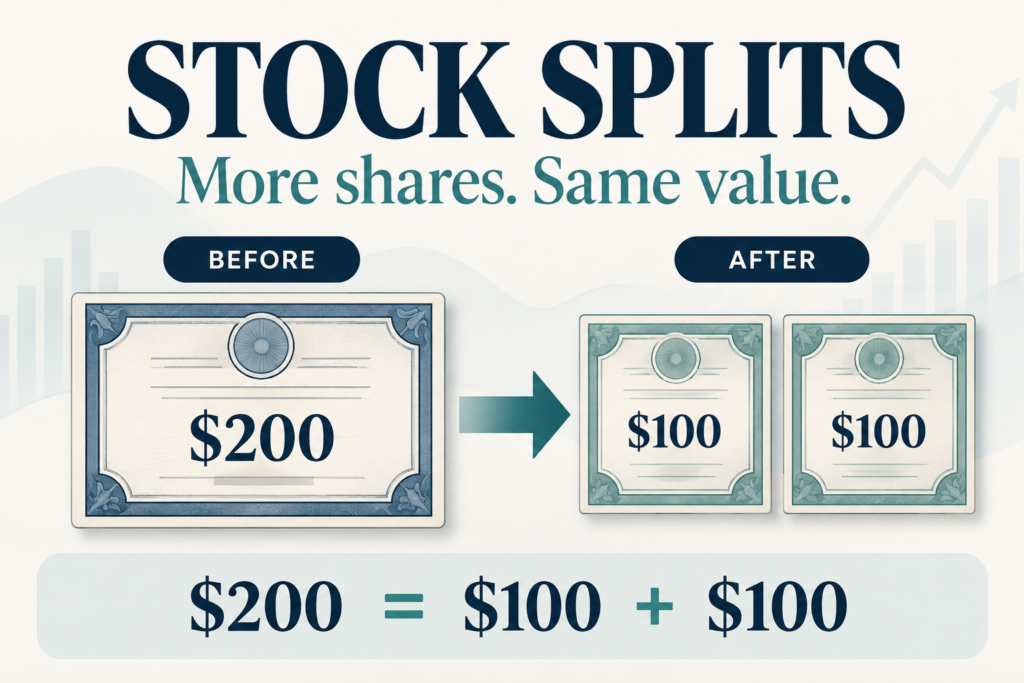
A stock split occurs when a publicly traded company divides its existing shares into a greater number of shares. The important thing to understand is that this process does not inherently change the total value of the company or the total value of your investment.
Let's use a simple example.
Imagine you own 10 shares of a company trading at $200 per share. Your investment is worth $2,000. The company then announces a 2-for-1 stock split, meaning that for every share you currently own, you will receive two shares.
Following the split, you now own 20 shares instead of 10. However, each share is worth $100 instead of $200. Your investment is still worth $2,000.
| Before split | After split | |
|---|---|---|
| Shares owned | 10 | 20 |
| Price per share | $200 | $100 |
| Total investment value | $2,000 | $2,000 |
| Ownership percentage | Unchanged | Unchanged |
Nothing has fundamentally changed about your investment. You simply own more shares representing the exact same ownership interest.
Think about it like exchanging a $100 bill for five $20 bills. You have more individual pieces of currency, but you aren't any wealthier. And this is the fundamental principle of stock splits.
A company can divide its shares 2-for-1, 3-for-1, 5-for-1, or even 20-for-1. Regardless of the ratio, the stock split itself does not create additional wealth.
And yet, investors frequently behave as though it does.
Why Do Companies Split Their Stocks?
If stock splits don't actually increase the value of a company, why bother? There are several legitimate reasons.
1. Making shares more accessible
Historically, one of the primary reasons companies announced stock splits was to make their shares more affordable to individual investors.
Imagine a company trading at $3,000 per share. An investor with $500 available to invest couldn't purchase even one whole share. Following a 20-for-1 stock split, that same company's shares would trade at approximately $150.
Suddenly, purchasing individual shares becomes much more practical.
Of course, this argument has become less compelling with the widespread availability of fractional share investing. Many brokerages now allow investors to purchase portions of shares regardless of their underlying price. Still, not every brokerage account supports fractional shares, and whole-share prices can matter for certain investors and trading strategies.
2. Increasing trading liquidity
Another potential benefit of stock splits is increased liquidity. Liquidity essentially refers to how easily an investment can be bought or sold without significantly affecting its price.
By increasing the number of shares available and reducing the price per share, companies may make trading more convenient for investors. This can sometimes improve market participation and trading efficiency.
However, a stock split doesn't automatically guarantee improved liquidity or a better investment.
3. Generating investor excitement
Here's where things get particularly interesting.
Stock splits are frequently announced after a company's share price has appreciated significantly. As a result, investors may interpret a split as a signal that management is optimistic about the company's future.
There is also a psychological component. A stock trading at $100 may simply feel more affordable than one trading at $1,000, even if the underlying valuation is identical.
This can create excitement, attract attention, and potentially increase short-term demand. But none of those things changes the fundamental financial reality of the business.
A stock split is not the same thing as increased earnings, higher revenue, improved profitability, or greater intrinsic value.
How Often Do Stock Splits Happen?
Stock splits aren't particularly rare, but they also aren't something that every publicly traded company does regularly. Their frequency tends to vary with market conditions.
During prolonged bull markets, when stock prices have appreciated significantly, companies may be more inclined to announce splits. During market downturns, traditional stock splits generally become less attractive because share prices are already declining.
There is also no universal share price that triggers a stock split. Some companies prefer to keep their shares trading within a relatively accessible price range. Others have historically allowed their stock prices to climb into the thousands or even hundreds of thousands of dollars.
A famous example is Berkshire Hathaway.
Warren Buffett has deliberately avoided splitting Berkshire Hathaway's Class A shares, which have reached extraordinarily high prices. The company instead offers much more accessible Class B shares, which underwent a 50-for-1 split in 2010.
Ultimately, stock splits are management decisions rather than automatic events.

- Invest in energy development: CrownForge Fund I focuses on developing oil and gas wells in the Texas Panhandle.
- Explore income beyond clinical work: Production revenues may provide investor distributions after project expenses and reserves.
- Understand the potential tax benefits: Learn how drilling-related deductions fit into the investment and what to review with your CPA.
- Watch the conversation: Jordan Frey and Ian Acrey discuss how oil and gas investments work, their potential benefits, and the risks to understand.
Some Famous Stock Splits in Investing History
Several major companies have announced highly publicized stock splits over the years.
| Company | Notable stock split | Year |
|---|---|---|
| Apple | 4-for-1 | 2020 |
| Tesla | 5-for-1 | 2020 |
| Tesla | 3-for-1 | 2022 |
| Amazon | 20-for-1 | 2022 |
| Alphabet (Google) | 20-for-1 | 2022 |
| Nvidia | 10-for-1 | 2024 |
| Walmart | 3-for-1 | 2024 |
These examples are particularly interesting because many of these companies have also experienced substantial long-term appreciation. But it's important not to confuse correlation with causation.
Apple didn't become a successful company because it split its stock. Rather, Apple's business success helped drive its share price higher, which contributed to management's decision to split the stock.
The same general principle applies to the other companies on this list. And that brings us to perhaps the most interesting modern example.
The Tesla Stock Split: What Actually Happened?
In August 2020, Tesla completed a 5-for-1 stock split that generated enormous enthusiasm among retail investors.
Tesla had already become one of the most talked-about companies in the market. Its electric vehicles, outspoken CEO Elon Musk, and extraordinary share price appreciation made it a favorite among investors looking for the next big thing.
The Tesla stock split only added fuel to that fire.
Tesla's first major split in 2020
On August 31, 2020, Tesla began trading on a split-adjusted basis following its 5-for-1 split. For every one share an investor previously owned, they now owned five.
A hypothetical investor holding 10 shares before the split would suddenly have 50. But their ownership percentage and total investment value remained unchanged at the moment of the split.
Interestingly, Tesla's share price had surged following the split announcement, reflecting considerable investor enthusiasm. This wasn't wealth created by the mathematical mechanics of splitting shares. Rather, it reflected changes in what investors were willing to pay for the company.
You can read the original Tesla announcement of its 2020 stock split for the company's explanation of its decision.
Tesla did it again in 2022
Just two years later, Tesla announced another stock split. This time, it was a 3-for-1 split, which took effect in August 2022.
According to Tesla's official announcement, the purpose was again to make stock ownership more accessible to employees and investors.
Taken together, the two splits meant that someone who owned one Tesla share before the 2020 split would own 15 shares after the 2022 split.
That's a 15-fold increase in the number of shares owned. Sounds pretty incredible, right?
Except, once again, the increase in share count did not represent a 15-fold increase in wealth. The company's actual investment performance depended entirely on how its stock price moved over time.
What happened to Tesla investors in the years afterward?
This is where the Tesla stock split story becomes particularly useful for understanding the difference between a corporate action and an actual investment return.
Following the 2020 split, Tesla experienced tremendous share price appreciation during the broader enthusiasm surrounding electric vehicles and growth stocks. However, the company's shares subsequently experienced dramatic volatility, including a substantial decline during 2022.
The 2022 split didn't protect investors from that decline. And it certainly didn't guarantee future returns.
Over the ensuing years, Tesla's share price continued to be influenced by the company's vehicle sales, profitability, competitive environment, interest rates, investor expectations, and broader market sentiment.
Investors who bought Tesla at different times experienced dramatically different outcomes, even when they participated in the same stock splits.
This is the important lesson.
If you purchased Tesla before its first split and held through the subsequent years, your investment outcome was determined by Tesla's business performance and market valuation, not by the fact that your original shares were divided into 15 smaller pieces.
Similarly, someone purchasing Tesla shares immediately after the 2022 split wasn't receiving a bargain simply because the share price was lower than before.
The split-adjusted price represented the same underlying company. And that's exactly how stock splits should be understood.
What Does a Stock Split Mean for the Average Investor?
For an investor who already owns shares of a company announcing a stock split, the immediate financial impact is generally straightforward.
Your brokerage account will automatically reflect the additional shares and adjusted share price. You don't need to request the new shares, make additional purchases, or sell anything.
The total market value of your holdings should remain essentially unchanged by the split itself, although ordinary market fluctuations can change that value once trading occurs. Your proportional ownership in the company also remains the same.
What about taxes?
For U.S. investors, a conventional stock split generally does not create a taxable event. You haven't sold your investment or realized a capital gain simply because the company divided its shares.
Instead, your existing cost basis is allocated across the larger number of shares.
For example, if you originally purchased 10 shares for $1,000 total and the company completed a 2-for-1 split, you would now own 20 shares with the same $1,000 aggregate cost basis. Your cost basis per share would decrease from $100 to $50.
When you eventually sell those shares, your capital gains or losses will generally be calculated using the adjusted cost basis.
There can be additional complexities involving fractional shares, corporate reorganizations, and other special circumstances. But for a straightforward stock split, there is usually nothing particularly complicated for the individual investor to do.
- Invest in energy development: CrownForge Fund I focuses on developing oil and gas wells in the Texas Panhandle.
- Explore income beyond clinical work: Production revenues may provide investor distributions after project expenses and reserves.
- Understand the potential tax benefits: Learn how drilling-related deductions fit into the investment and what to review with your CPA.
- Watch the conversation: Jordan Frey and Ian Acrey discuss how oil and gas investments work, their potential benefits, and the risks to understand.
Can Stock Splits Actually Make Investors Money?
Technically, yes, but not because of the split itself.
If a stock split announcement attracts new investors and increases demand for a company's shares, its market price may rise. An existing shareholder would benefit from that appreciation.
However, the same psychological factors that generate excitement can also create opportunities for speculation and overvaluation. A company that announces a stock split may experience a short-term rally, only to see its shares decline afterward.
And predicting those price movements consistently is extraordinarily difficult.
This is why I think stock split investing, at least when it involves buying shares simply because a split was announced, begins to look a lot more like speculation than long-term investing.
You're essentially betting that other investors will become sufficiently excited about the announcement to drive prices higher. Could you make money doing that? Absolutely. But you could also lose money.
This is similar to the reasoning I explored in my post about why I decided against investing in a new medical IPO. Even when a company seems promising, trying to predict how investors will react to a particular event is an entirely different proposition from investing based on a disciplined long-term strategy.
The stock split itself doesn't provide any fundamental reason why the company should suddenly be worth more.
What About Reverse Stock Splits?
Before we finish, there's one other concept worth understanding.
A reverse stock split is essentially the opposite of a traditional stock split. Instead of dividing existing shares into more shares, the company consolidates them into fewer shares.
For example, during a 1-for-10 reverse stock split, an investor holding 100 shares worth $2 each would end up with 10 shares worth $20 each. The total investment value would remain $200 immediately following the split, assuming no other price changes.
Companies sometimes pursue reverse splits when their share prices have fallen significantly, potentially to satisfy minimum exchange listing requirements or improve the perception of their stock.
As the SEC explains in its guide to reverse stock splits, these corporate actions can be associated with companies attempting to maintain exchange listing requirements.
But just as with traditional stock splits, the mechanics themselves don't inherently create or destroy shareholder value. The underlying company's financial condition remains far more important.
Why I Don't Pay Much Attention to Stock Splits
Here's where I'll bring this back to my own investing philosophy.
I have never made an investment decision based on an upcoming stock split. And I don't anticipate starting anytime soon.
As I've discussed extensively here, my primary stock market investing strategy revolves around low-cost, broadly diversified index funds.
In fact, I recently broke down my actual approach and returns in my post examining my 2025 investment portfolio performance.
I am not attempting to identify the next Tesla, predict which company will announce a split, or capitalize on short-term changes in investor sentiment. Instead, I'm focused on consistently investing, minimizing fees, and allowing long-term compounding to do the heavy lifting.
When Apple, Tesla, Amazon, or another major company announces a stock split, I may already own that company indirectly through an index fund. And that's perfectly fine.
The index fund will reflect the corporate action automatically. I don't need to do anything.
This is one of the many reasons I appreciate passive investing
As I discussed in 7 Things to Do When Index Funds Get Boring, the temptation to tinker with investments can actually be one of the biggest obstacles to successful long-term investing.
We physicians are particularly susceptible to this. In medicine, we are trained to identify problems and intervene to make things better. Unfortunately, that same instinct doesn't always translate well to investing.
Sometimes doing less really is doing more.
My investing plan is designed to work without requiring me to make predictions. You can see exactly how I've structured that approach in our written financial plan.
Does that mean individual stock investing is always wrong? Of course not. Some investors enjoy researching individual companies and allocating a “fun money” portion of their portfolio toward those investments. I just don't think it should be the core of one's investment portfolio.
And I simply don't believe that stock splits, by themselves, represent a compelling reason to buy or sell a company. I certainly don't think physicians need to spend their limited free time trying to trade around them.
The Bottom Line on Stock Splits
Ultimately, stock splits are a perfect example of something that can generate enormous attention in the financial media without fundamentally changing the value of an investment.
They can make shares more accessible, potentially improve trading liquidity, and generate enthusiasm among investors. But they don't magically create wealth.
The Tesla stock split story illustrates this particularly well. Investors who owned Tesla through its 2020 and 2022 splits saw their share counts increase dramatically, but their ultimate returns depended on the company's subsequent stock performance. The same is true for Apple, Amazon, Nvidia, and every other company that has split its shares.
For everyday investors, understanding stock splits is valuable financial literacy. Knowing how they work helps you avoid making emotional decisions based on misleading headlines or a suddenly lower share price.
And for physicians pursuing financial freedom, that's really the most important takeaway.
You don't need to react to every development in the stock market to become a successful investor. In fact, sometimes the best investing decision is to understand what's happening and then do absolutely nothing.
What do you think? Have you ever owned a stock that underwent a split? Did the announcement influence your decision to buy, sell, or hold? Or, like me, do you prefer to let your index funds handle all of this behind the scenes? Let me know in the comments below!