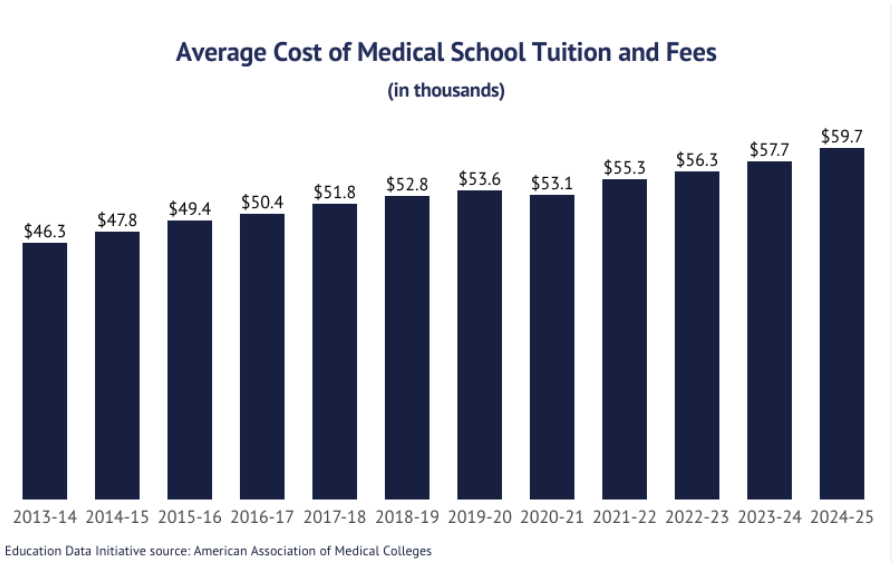
When I graduated from medical school, I was staring at a number that would make most people’s stomach drop. According to AAMC survey data for the class of 2025, the median education debt among medical school graduates who reported debt was $215,000. That includes premedical education debt, not just medical school loans. That was the highest answer choice in the multiple-choice question I often share when speaking with medical students or residents.
More than two hundred thousand dollars. Before an attending paycheck.
That is a substantial balance to carry into residency, when an attending-level income is still years away. And it often comes with interest accruing long before you have much room in your budget to pay it down.
And yet, this is the reality for most medical students. And that means erasing your student debt is one of the most impactful financial moves that you will make on the road to financial freedom.
Put simply, having an intentional plan for your loans can help you move toward financial freedom. Depending on your situation, that may mean aggressive repayment, pursuing forgiveness, or balancing repayment with investing.
In this post, I want to share my perspective on medical student loans, how I approached them, and how I ultimately paid mine off five years after finishing training through a combination of aggressive repayment and Public Service Loan Forgiveness. I also want to discuss the major student loan changes introduced in 2026 and how they impact current and future physicians.
The Reality of Medical School Debt
Let’s start with the facts. The $215,000 median education debt among indebted graduates in that survey is just that, a middle value. Many graduate with more. And we typically take on this debt during a time when financial literacy is low and income is zero.
I know that was true for me.
When I was in medical school, I took out loans because that was the only way I could make it work. I did not have a trust fund. I did not have family paying my tuition. But I had a dream of becoming a doctor, and loans were the path to make that dream a reality.
There is nothing wrong with that.
The problem is not the existence of the loans. The problem is how we think about them once we finish training.
Your Loans Should Not Define Your Financial Future
We often think of medical school debt as a life sentence. I strongly disagree with that mindset.
Yes, the number is big. Yes, the interest can be significant. But as physicians, we also have a significant earning potential. That earning potential is the tool that allows us to take control of the debt instead of letting it control us.
The mistake I see most often is this: new attendings treat their student loans as just another monthly bill. They refinance or enroll in a long-term repayment plan and commit to paying the minimum for 20 to 25 years.
On paper, it feels manageable. In reality, it is expensive.
Stretching repayment over decades can mean paying substantially more interest. But the lowest monthly payment is not automatically a mistake, either. If you are pursuing PSLF or another forgiveness option, the right strategy may look very different from an aggressive payoff plan. The mistake is choosing a payment without understanding where it leads.
My philosophy was different. I did not want to coexist with my loans. I wanted them gone.
The Strategy: Save at Least 20 Percent and Control Lifestyle Creep
One of the foundational principles I teach is simple: save at least 20 percent of your gross income.
Early in your attending career, some of that money may go toward paying down student loans. But the allocation should fit your interest rates, retirement opportunities, and forgiveness eligibility. If your balance equals your annual gross income, directing 20 percent of that income toward the principal would cover it in five years before interest. With interest, the payoff takes longer unless your payments increase.
For me, the important change was creating that margin and giving every dollar a purpose.
When I became an attending, I resisted the temptation to immediately inflate my lifestyle. No luxury car financed on a whim. No dramatic expansion of spending just because my paycheck was suddenly larger.
Lifestyle creep is the silent killer of financial progress. When your expenses rise in lockstep with your income, you never create a meaningful margin between what you earn and what you spend. Without a margin, it becomes much harder to pay down debt, invest for the future, and move toward financial freedom.
By keeping my lifestyle reasonable and directing significant cash flow toward my private loans after training, I made progress. My federal loans followed a different path: Public Service Loan Forgiveness. As I have shared in that account, I deferred loans during training and later benefited from adjustments that credited qualifying past periods. In October 2025, my remaining federal balance was forgiven, about five years after I finished training. That timeline included credit for earlier qualifying employment; PSLF is not a five-year forgiveness program.
Today, I am free of my education debt. That freedom changes everything.

- Free locum tenens education for physicians and APPs. Not a staffing agency.
- Real physician experiences through the Locumstory podcast.
- Free, self-paced Locum Tenens Crash Course.
- Join me, Dr. Trevor Cabrera, and Ben Nanney for live Q&A on multi-state licensing and taxes.
Life After Loan Payoff
Once your loans are gone, the cash flow that used to go toward debt payments becomes a powerful wealth-building tool.
Instead of sending thousands of dollars each month to a loan servicer, you can redirect that money to:
- Retirement accounts such as a 401k or 403b
- Backdoor Roth IRAs
- Taxable brokerage investments
- Real estate
- Practice investment or other entrepreneurial ventures
The key is that you now have options.
And guess what? You also have more room for spending after you get firmly on the path to financial freedom by managing your spending, eliminating your debt, and investing enough to reach your goal nest egg in the future.
Reducing debt can free up cash flow and expand those options. How quickly that moves you toward financial independence depends on your interest rates, repayment strategy, investment returns, and goals.
The 2026 Student Loan Changes: What Physicians Need to Know
The federal loan rules changed in 2026, but the effects are not identical for every borrower. Your loan dates and whether you are still in school matter. Here are the changes I would want physicians to understand before making a decision.
First, new borrowing limits can change how students finance medical school
Beginning July 1, 2026, affected new professional-school borrowers face limits of $50,000 per year and $200,000 in aggregate professional-study borrowing, alongside an overall federal student borrowing lifetime limit of $257,500. Grad PLUS loans are generally no longer available to new graduate and professional borrowers. The Department of Education explains the limits here.
Some continuing students who were enrolled and had borrowed for the same program before July 1, 2026, qualify for a limited transition exception. Do not assume the new caps apply to every current student in the same way. Check your status with your school’s financial aid office and the current Grad PLUS guidance.
Second, repayment options depend on when you borrowed
The new Repayment Assistance Plan, or RAP, and Tiered Standard plan became available July 1, 2026. Under RAP, payments are based on adjusted gross income, with dependent adjustments and a $10 monthly minimum. Remaining balances can be forgiven after 30 years of qualifying payments. That is different from a calculation based on discretionary income.
Borrowers with older loans may have other choices, while receiving a new loan can change eligibility. PAYE and ICR are being phased out by July 1, 2028. Before switching plans or consolidating, compare the options available for your actual loans using Federal Student Aid’s current repayment guidance.
Third, PSLF still requires its own strategy
PSLF generally requires eligible Direct Loans, 120 qualifying monthly payments under a qualifying repayment plan, and full-time work for an eligible employer. Submitting employment certification annually and when changing employers helps you track progress. Do not assume that every repayment plan or every hospital job qualifies.
If you are pursuing PSLF, extra payments can reduce the balance that would otherwise be forgiven. And refinancing federal loans into private loans gives up federal benefits, including PSLF eligibility on those loans. That is why I treat my private-loan payoff and federal-loan forgiveness as separate decisions.
Finally, understand how your plan handles interest
RAP subsidizes monthly interest left unpaid after you make the required monthly payment. That is a specific benefit of that plan, not a blanket promise that every income-driven plan prevents your balance from growing. Check how interest and any subsidies work under the plan you actually use.
The practical lesson is simple: choose a strategy using current rules and your own loan details. My path benefited from past policy adjustments that a new borrower should not assume will be available again.
- Free locum tenens education for physicians and APPs. Not a staffing agency.
- Real physician experiences through the Locumstory podcast.
- Free, self-paced Locum Tenens Crash Course.
- Join me, Dr. Trevor Cabrera, and Ben Nanney for live Q&A on multi-state licensing and taxes.
My Position on Medical Student Loans
So where do I stand?
I do not believe medical student loans are inherently evil. They are a tool. For many of us, like me, they are the only path to becoming a physician.
But tools require skill to use properly.
If you take on $200,000 or more in debt and then ignore it, stretch it out for decades, and inflate your lifestyle immediately upon becoming an attending, it will absolutely hinder your financial life.
If instead you approach it with a plan, control your spending, save aggressively, and understand programs like PSLF, it becomes a temporary phase rather than a permanent burden.
Five years after finishing training, I eliminated my loans through a combination of disciplined payments and Public Service Loan Forgiveness. That did not happen by accident. It happened because I treated my debt as a priority, not a background bill.
The best time to understand your options is before repayment begins, including during training. But even if you are mid-career or later with persistent debt, it is worth revisiting the plan.
For medical students, residents, and physicians of all ages reading this, here is my advice:
- Know your numbers. Understand exactly how much you owe and at what interest rates.
- Have a repayment strategy before you graduate. Compare forgiveness eligibility, repayment options, interest costs, and the federal benefits you would give up before refinancing.
- Control lifestyle creep. Your biggest wealth-building years start when you become an attending. Do not waste them.
- Save at least 20 percent of your income. If that goes to loans initially, that is fine. It is still building your financial foundation.
Medical school debt is real. It is significant. But it does not have to define you.
With the right mindset and a clear strategy, it can be a stepping stone rather than a stumbling block. And on the other side of that debt is something incredibly powerful: financial freedom, on your own terms.
And for those of you yelling at your screen about when you should pay off debt versus invest your money, I answer those questions here.
What do you think? How did you manage or are you managing your medical student loans? Do you string it out or try to get rid of it as quickly as possible? What has been the impact on your overall finances? Let me know in the comments below!