
Lifestyle creep is one of those personal finance concepts that everyone understands in theory. You make more money, you start spending more money, and eventually the things that once felt like luxuries simply become normal. For doctors, however, lifestyle creep has some unique characteristics.
Most of us spend somewhere between 7 and 10 years in medical school and training while making very little money relative to the amount that we work. During that time, our lifestyles are constrained largely by necessity. We don't necessarily avoid expensive cars, big houses, luxury vacations, or nice restaurants because we have developed some incredible sense of financial discipline. A lot of the time, we simply can't afford them.
Then one day we finish training and our income may increase four- or five-fold almost overnight. That is an incredible opportunity, but it is also exactly why lifestyle creep can be so dangerous for doctors.
I've certainly experienced it myself. My lifestyle today is objectively more expensive than it was when I finished training, and in some categories it is significantly more expensive. But I also don't think lifestyle creep is inherently bad. The key is understanding where it happens and making sure that the things you spend more money on actually reflect your priorities.
Because when you look closely, lifestyle creep tends to show up in some very predictable places.
• Most side gigs take time to build. This one pays fast.
• I do short, physician-only surveys on Sermo between cases and get paid for my input.
• They take just a few minutes and the money hits PayPal or gift cards right away.
• It’s not replacing my OR income, but it covers the little things that have a big impact—gifts, kids' activities, or the next date night.
The 7 Biggest Sources of Lifestyle Creep for Doctors
Let's start with perhaps the most stereotypical example: the car.
1. The Doctor Car
I recently heard a physician just finishing fellowship talking about the very expensive car that they planned to lease almost immediately after graduation. There was nothing particularly unusual about this. In fact, it is almost a rite of passage. You spend years driving whatever vehicle you can afford, whether that's an old Honda, a hand-me-down car, or something that you're simply hoping will make it through another Buffalo winter. Then you become an attending and suddenly think, “I'm a doctor now. I should drive a doctor car.”
My experience went almost in the opposite direction. For roughly my first five years as an attending, I continued driving what I lovingly referred to as my beater car. Eventually, my wife got a new Cadillac Escalade and I inherited her previous car.
Could I have afforded a nicer car sooner? Absolutely. But it wasn't particularly important to me, and that's really the point. The problem isn't buying an expensive car. The problem is allowing your new income to automatically dictate your new spending without ever deciding whether that purchase is actually something that you value.
A $1,500 monthly car payment may not seem like much when you're suddenly making $30,000 per month. Add that payment to everything else on this list, however, and the attending paycheck starts disappearing remarkably quickly.
2. The Doctor House
The house is basically the bigger version of the car problem. During residency, most of us rent or live relatively modestly. Then we graduate and immediately start looking at houses based on our new attending income rather than our actual financial situation.
I'll admit that I broke one of the classic physician finance rules here. I bought what could reasonably be called a doctor house when I moved back to Buffalo after training, but I did it very intentionally. Our circumstances were somewhat unique because I was moving back to my hometown, we knew the area extremely well, and we had strong reasons to believe that we would stay there long term. Most importantly, the purchase fit within our written financial plan.
That doesn't eliminate the financial impact. A bigger house means a bigger mortgage, but the lifestyle creep doesn't stop there. It also means more furniture, more maintenance, higher utility bills, more landscaping, higher insurance costs, and plenty of other expenses that somehow seem to multiply with square footage.
There is another reason physicians should be particularly cautious about buying a huge house immediately after training: your first attending job may not be your last. A significant number of physicians change jobs relatively early in their careers, and buying too much house can make that transition much more difficult. If you buy a massive home and then decide two years later that the job isn't right for you, that house can become another set of golden handcuffs tying you to a situation you don't want.
Sometimes renting for a year or two isn't delaying adulthood. It is simply buying flexibility while you figure out what you actually want your attending life to look like.
3. Our Kids' Education
This one hits very close to home for me because private school is probably one of the biggest examples of lifestyle creep in our household.
When physicians start earning more money, many of us naturally begin thinking about what that money can provide for our kids. Education tends to sit near the top of that list, and you'll see plenty of physician families who choose private school even when they live in areas with good public school systems.
We currently send all three of our boys to private school. With our youngest now entering school, private school tuition has become one of our largest household expenses. In fact, it now exceeds our mortgage.
There is no way for me to pretend that isn't lifestyle creep. We could send our kids to public school and save a tremendous amount of money, and many physicians specifically buy expensive homes in neighborhoods with excellent public schools. From a purely financial standpoint, paying a premium to live in one of those neighborhoods and then paying private school tuition on top of it can be difficult to justify.
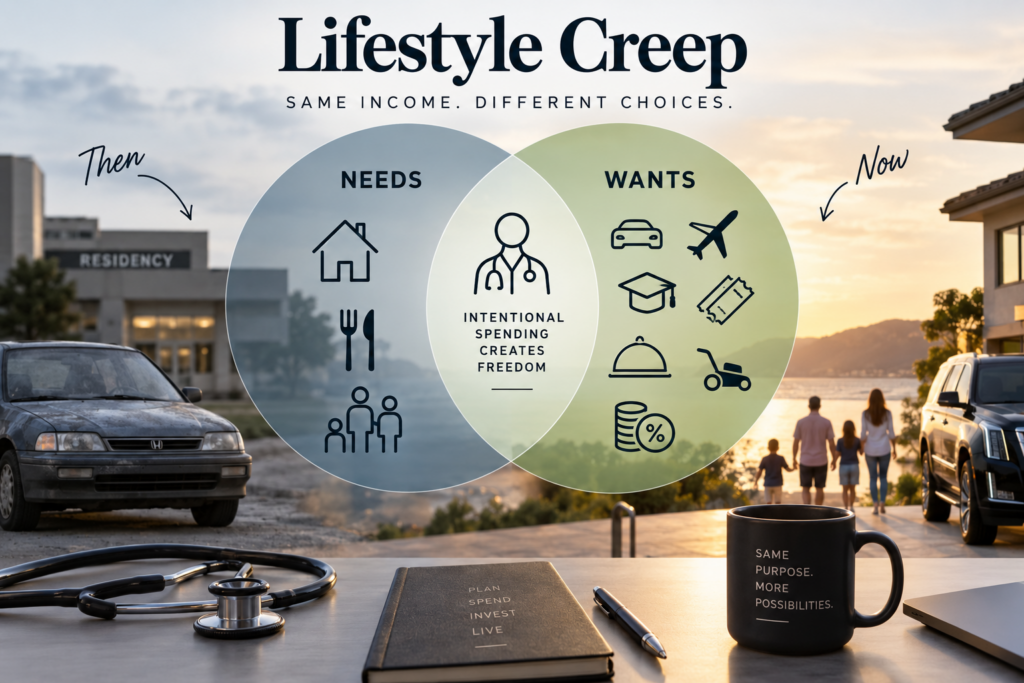
Yet this is an expense that we have consciously chosen, and that's an important distinction. Lifestyle creep becomes problematic when your spending increases mindlessly. Intentional spending is different. You identify something that matters deeply to you and consciously decide that it deserves a larger portion of your resources.
That doesn't make the expense disappear or somehow transform it into a financially optimal decision. It simply means that we understand the tradeoff we're making and have decided that, for us, it is worth it.
4. Vacations and Experiences
Vacations and experiences are particularly sneaky areas of lifestyle creep because luxury has an incredible ability to reset our baseline expectations.
Imagine taking your first really expensive vacation. You fly first class, stay at an incredible resort, and have an oceanfront room. Everything is easy, comfortable, and memorable. Then you go home and start planning another vacation a year later. Suddenly, flying economy and staying at the perfectly nice Marriott down the street feels like a downgrade even though there is absolutely nothing wrong with either of those things.
The Marriott didn't change. Your baseline did.
This applies beyond vacations too. Maybe you used to be thrilled just to get tickets to a football game. But now you want great seats, preferred parking, and access to the club. Concert tickets become VIP tickets. A weekend getaway becomes a luxury resort. Regular admission becomes the premium package because you've experienced the upgrade and now it feels difficult to go backward.
I've certainly noticed some lifestyle creep in experiences for our family. And I don't necessarily regret it. One of the reasons that I have worked so hard to improve our finances is so that money can actually improve our lives. Spending money on experiences with my wife and kids is something that I value tremendously.
At the same time, every upgrade creates the possibility of establishing a new baseline. That's why intentional spending matters so much. I want to enjoy an upgraded experience because I've decided it is worth paying for. Not because I've unconsciously decided that anything less is no longer acceptable.
5. Food
Food may actually be the lifestyle creep category that surprised me the most.
When I've looked closely at our spending, food has become one of our biggest household expenses. Part of that is simply buying more expensive food. We can afford better groceries, we tend to choose nicer restaurants when we go out, and eating out happens more frequently than it did when I was a resident or even when I was a new attending.
But the biggest change has probably been convenience.
During training, there simply wasn't an unlimited option to say, “We're tired. Let's order dinner.” We had a budget, and that budget meant cooking and eating at home much more frequently. It wasn't necessarily some intentional decision to be frugal. The financial constraint made the decision for us.
Now imagine a typical weekday evening. I've been operating all day, my wife has been working, one kid has baseball, another has something else, and everyone gets home late. Nobody wants to cook, so suddenly ordering dinner starts looking pretty appealing. Occasionally doing that barely registers financially, but doing it repeatedly over an entire year creates a significant new expense.
Food is particularly susceptible to lifestyle creep because there usually isn't one giant purchase that gets your attention. Instead, it's $80 here, $120 there, groceries that cost a little more than they used to, and another restaurant meal over the weekend. Convenience slowly becomes routine, and routine eventually becomes your new lifestyle.
• Most side gigs take time to build. This one pays fast.
• I do short, physician-only surveys on Sermo between cases and get paid for my input.
• They take just a few minutes and the money hits PayPal or gift cards right away.
• It’s not replacing my OR income, but it covers the little things that have a big impact—gifts, kids' activities, or the next date night.
6. Paying Other People to Do Things
This is another category where our spending has unquestionably increased.
Earlier in life, if something needed to be done, we usually did it ourselves. You cut your grass, cleaned your house, did your laundry, shoveled the driveway, and figured out how to fit all of those things into your schedule because paying someone else wasn't really an option.
As income increases, however, something else often becomes more scarce: time.
That's certainly true for me. Between being a full-time reconstructive plastic surgeon, running businesses, managing real estate investments, coaching baseball, and most importantly being a husband and father, my time has become increasingly valuable to me. So we outsource things. We send out laundry, pay someone to handle landscaping, and hire people to perform jobs that we theoretically could do ourselves.
Financially, that is absolutely lifestyle creep. But I also think this category illustrates better than almost any other why lifestyle creep shouldn't automatically be treated as evil.
Money is ultimately a tool, and time is a finite resource. If spending $50 saves me two hours that I can spend coaching my son's baseball team or hanging out with my family, that may be a fantastic trade. The important question isn't simply, “Could I do this myself?” It is whether outsourcing that task represents a worthwhile use of my money.
Sometimes the answer is going to be yes.
7. Taxes
Taxes are the lifestyle creep category that almost nobody thinks about. Yet the more expensive your lifestyle becomes, the more taxes and other carrying costs often become attached to it.
Buy a larger house and your property taxes usually increase. Purchase a second home and you've created another property tax bill. Spend more money and you're paying more sales tax, something I am particularly aware of living in New York. Own more expensive property in general and you frequently find that insurance, maintenance, fees, and other costs rise right along with it.
Some of this is obviously indirect. Your lifestyle itself isn't necessarily changing your income tax bracket. But the broader point is important because expensive things usually come with expensive carrying costs, and the sticker price is rarely the entire price.
A $1.5 million house isn't simply a bigger mortgage than a $700,000 house. It potentially means higher property taxes, insurance, maintenance, utilities, furnishings, and landscaping year after year. The same principle applies to vacation homes, cars, boats, and plenty of other lifestyle upgrades.
That's why every lifestyle upgrade deserves to be evaluated based on its total cost rather than simply whether you can afford the initial purchase.
Lifestyle Creep Isn't Actually the Enemy
After going through this list, it would be easy to conclude that the answer is simply for doctors to avoid lifestyle creep completely. I don't think that's realistic, and more importantly, I don't think that's desirable.
We work incredibly hard. We delay gratification for years while many of our friends outside of medicine start earning money, buying homes, traveling, and building their lives. Eventually, we should enjoy some of the fruits of that work because money has no intrinsic value. Its value comes from what it allows us to do for ourselves and the people around us.
The goal therefore isn't to prevent your lifestyle from ever improving. The goal is to improve it intentionally.
Paula Pant, the creator of Afford Anything, has one of my favorite frameworks for thinking about this: “You can afford anything, but not everything.” Her broader Afford Anything philosophy captures the tradeoff perfectly.
Even high-income doctors have limited resources in the face of rampant lifestyle creep. If you choose the doctor house, luxury cars, private school, first-class vacations, expensive restaurants, premium sporting tickets, and every imaginable convenience simultaneously, eventually something has to give. Usually that something is your savings rate.
And that's where lifestyle creep becomes dangerous, especially for doctors with pent up delayed gratification.
Create the Margin First
The basic formula for building wealth really isn't complicated. You earn money, spend less than you earn, and invest the difference. The larger that margin becomes, the faster you build wealth and the more flexibility you ultimately create in your life.
That's why I have consistently targeted a 20% savings rate as a baseline for physicians seeking financial freedom. Once you have created that margin and are investing enough to remain on track for your financial goals, what you do with the rest becomes much more personal.
My lifestyle creep isn't going to look exactly like yours. Our family spends an enormous amount on our kids' education, while cars aren't particularly important to me. Someone else may send their kids to public school and own a Porsche. Another physician may live in a modest house but travel internationally five times each year.
None of those people is necessarily doing anything wrong. Problems arise when we stop making those decisions consciously and simply allow every part of our lifestyle to rise alongside our income.
Don't Let Lifestyle Creep Create Golden Handcuffs
The ultimate risk isn't spending money. It's creating a lifestyle that requires you to keep earning at your current level forever.
That's how doctors earning $400,000, $500,000, or even $1 million annually can still feel financially trapped via lifestyle creep. Every dollar is already spoken for between the mortgage, cars, tuition, vacation home, travel, restaurants, and everything else that gradually became part of the family's normal lifestyle. Meanwhile, saving and investing become whatever happens with the money left over.
Eventually, you can't reduce your clinical schedule because you need the income. Leaving a toxic job becomes harder. Taking a lower-paying position that you would enjoy more feels impossible, and walking away from medicine altogether isn't even an option.
Your lifestyle has started making those decisions for you.
That is the real danger of lifestyle creep for us all as doctors
Financial freedom isn't about spending as little money as possible or accumulating the biggest number on a spreadsheet. It's about building enough financial margin that money gives you more choices rather than fewer of them.
So buy the nicer car if cars bring you joy. Send your kids to private school if education is one of your family's priorities. Take the incredible vacation, buy the good seats, or pay someone else to cut the grass if those things genuinely improve your life.
Just don't do all of them simply because you're a doctor and you think that's what doctors are supposed to do. Spend intentionally, save and invest enough to stay on your chosen path, and then let your lifestyle creep exactly where you want it to.
What do you think? What has your experience with lifestyle creep been? Where does lifestyle creep most commonly show up for doctors? How should we manage it to avoid the golden handcuffs? Let me know in the comments below!



13 Responses
Excellent
We doctors represent 1% of top earners , buen able to spend 99 % of what we earned
In other words , not everyone , but in tbe majority of cases ending working up for other
A true commitment
You left out donations. I just retired, and it’s hard to stop (well, slow down) simply giving when we see a need.
Excellent shout out!
Great advice!
You forgot “fooling around” which so often ends in trading in the first wife for a Trophy Wife
Now the poor doctor must work 10x harder to pay the attorney, the alimony, & support his original kids in the manner to which they are accustomed, while thd new wife promptly produces a new family & everyone needs a new fur coat, new car, new house, etc.
Sadly a stereotype that over becomes a self fulfilling prophecy in our profession
Let’s see; you admit you bought an expensive doctor house, have an expensive Cadillac Escalade, three expensive private school tuitions, high eating costs, and lifestyle creep on experiences and home maintenance costs. Now do you consider this “practicing what you preach,” Dr Prudent? Seriously?
Absolutely! Thats the beauty. By living in my prudent era, I now can relax the reigns since my path to financial freedom is on relative auto pilot. I talk about it more here: https://prudentplasticsurgeon.com/prudent-era/
Very true. Even wealthy people budget their spending – that’s why they’re wealthy!
All are so true! Best part is as kids get older and move out you can turn your doctor house into a payed off empty nest house, school tuition goes away with their planned 529’s. I enjoy the creep (especially my Doctor car, ha!). However, being financially responsible and saving appropriately is key! Go Bills!
Love that perspective!
Great article. I’m 88 years old and practiced for 55 years having retired two years ago. The first half of my working life, we were very conservative. This allowed me to invest enough so that now I actually earn more from investments than I ever earned from my practice. Do I need all that money? No, of course, not, but having it gives me comfort in my older age. Now, when we travel, it’s all luxury but of course, at my age it seems more important. It’s just too bad that more younger physicians don’t follow the sage advice that you offered.
Thank you for sharing Howard!