My wife Selenid and I agree on most of the big financial decisions involving our kids. But not all of them. And our biggest ongoing hypothetical debate is about paying for our kids' graduate school.
And trust me, we are not averse to paying for education.
Private elementary school? We debated it, but ultimately agreed. And starting this year, with all three kids enrolled, we are spending roughly $8,000 every month on tuition. I recently shared the full numbers and my mixed feelings about spending nearly $100,000 each year on private school.
College? We agree there too. Assuming our financial situation continues along its current trajectory, we plan to help significantly and hopefully pay for most, if not all, of our kids' undergraduate education. We've been planning for that expense since they were young, using a combination of 529 savings, future cash flow, and the other strategies I've written about in my five ways to pay for your kids' college.
But graduate school?
That's where the agreement ends.
My position is pretty simple. Once our kids finish college, they're on their own.
However, Selenid thinks I'm nuts.
Why I Want to Pay for College
Before making me sound like some financial hardliner, let me explain where I draw the line and why.
For our family, undergraduate education is something we expect to provide. College certainly isn't the only pathway to a successful life, and there are plenty of careers where a four-year degree isn't necessary. But for many professions, a bachelor's degree has increasingly become the baseline credential needed just to get in the door.
At the same time, college is incredibly expensive. According to the College Board's 2025–26 data, average published tuition and fees for 2025-2026 are nearly $12,000 annually at an in-state public university and $45,000 at a private nonprofit college. Add housing, food, books, transportation, and everything else, and the total cost can become staggering.
In fact, this is one of the reasons I feel strongly about helping our kids with undergraduate education. I want them to have options.
If one of them decides that his passion is history, art, philosophy, or another field that may not offer a huge financial return, I don't necessarily want the price of college dictating that decision. If we're fortunate enough to give them the freedom to pursue something meaningful without starting adult life buried in debt, I think that's an incredible gift.
There is a catch though.
Once they graduate, they're responsible for making that life work.
If you choose a career that pays $50,000 annually because you love it, that's completely fine with me. But you also need to build a lifestyle that works on $50,000. Mom and Dad aren't going to subsidize the difference indefinitely.
And that philosophy is basically where my graduate school argument begins.
Graduate School Feels Different to Me
Once you decide to pursue graduate education, I think the equation changes.
You're an adult. You already have a college education. Now you're making an additional investment in yourself with the expectation that it will provide some combination of increased earning potential, career opportunities, or personal fulfillment.
At that point, I think you need some skin in the game.
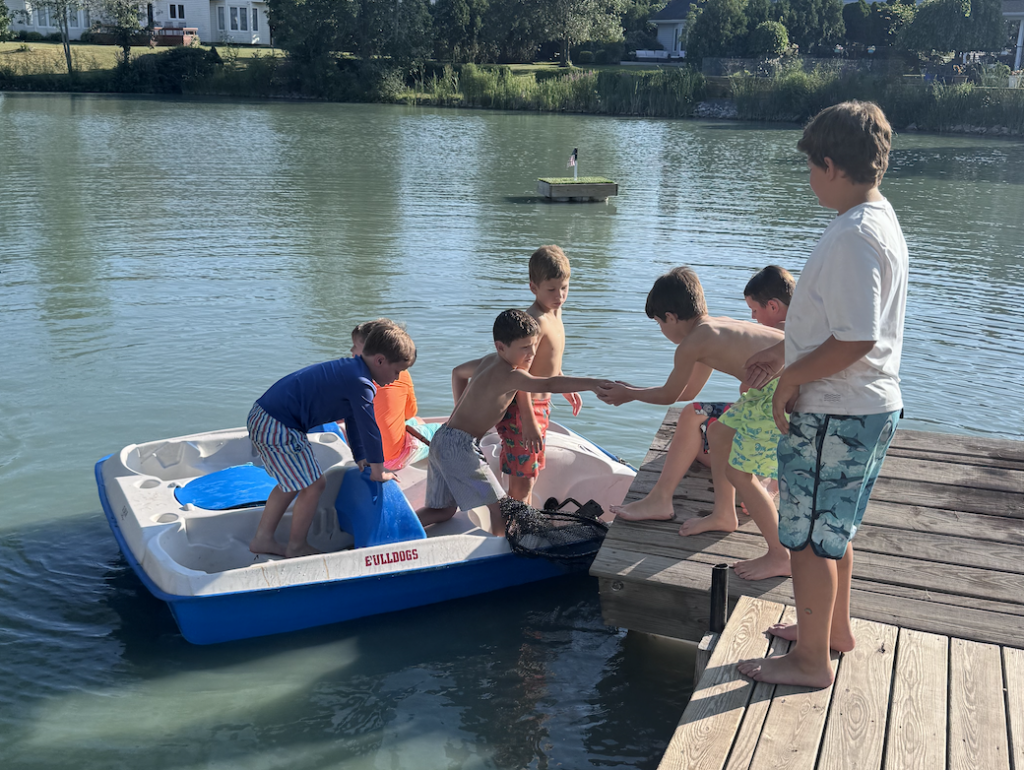
If one of my sons wants to go to medical school, law school, business school, or pursue another advanced degree, I want him to sit down and ask some very real questions:
- How much is this going to cost?
- How am I going to pay for it?
- What will my likely income be afterward?
- Is the investment worth it?
Those are incredibly important questions. Medical students in particular need to ask them. The AAMC reports that the median education debt among medical school graduates in the class of 2025 who had education debt was $215,000, while the median four-year cost of attendance for the class of 2026 was nearly $298,000 at public medical schools and more than $408,000 at private schools.
And the financing landscape for graduate and professional education has changed significantly. New federal borrowing limits took effect July 1, 2026, and Grad PLUS loans are no longer available to new borrowers. Qualifying continuing students have a limited transition exception. These changes make the decision even more consequential. Federal Student Aid explains the current borrowing limits and transition exception.
That actually strengthens my belief that someone choosing graduate school needs to understand the investment they are making.

- Carlton Lane works exclusively in accredited, private-market real estate.
- The firm operates independently of sponsors, fund families, and proprietary products.
- Independent third-party diligence firms re-underwrite opportunities, stress assumptions, and surface risks.
- Carlton Lane focuses on set-term projects with a clear investment thesis and patient capital deployment.
My Own Student Loans Definitely Influenced Me
I'll admit that my own experience creates a huge bias here.
My parents told me that they weren't in a position to pay for my college education. If I wanted to go to Emory, I could go, but I was going to need loans. So that's what I did.
Then I went to medical school and needed to borrow more. Eventually I ended up with hundreds of thousands of dollars of student loan debt.
Was that financially ideal? Absolutely not. But the return ended up being worth it tangibly and intangibly.
I've written extensively about the mistakes I made with those loans. I didn't understand them well enough. I let interest accumulate. Mistakenly I deferred loans throughout training. I made plenty of decisions that I would advise a medical student against today. But I also knew something very clearly.
This was my decision.
The money was real. The consequences were real. And if I wanted this enormous investment in my education to pay off, I needed to make it work. I don't think struggle is automatically virtuous. I'm certainly not going to manufacture financial hardship for my children just because I experienced it. But I do think responsibility has value.
There is something powerful about understanding that your decisions have consequences and that ultimately you are responsible for creating the life you want.
Selenid Sees It Differently
This is where I need to give my wife's side of the argument a fair hearing.
Her position comes from exactly the same place as mine: wanting our kids to become happy, independent, successful adults. She just sees a different route to getting there.
Her argument is essentially this: if we've built enough wealth that we can afford to pay for graduate school without compromising our own financial future, why wouldn't we? Why intentionally saddle our child with $200,000 or $300,000 of debt simply to teach a lesson?
It's a fair question.
Starting a career without student loans is an enormous financial advantage. Instead of making loan payments, our kids could invest, buy a home, start a business, or begin building their own financial independence immediately.
Selenid also brings a very different educational experience to this conversation.
Her mother told her that paying for college wasn't financially possible. Selenid ultimately earned a Gates Millennium Scholarship that fully funded her undergraduate education and later her PhD studies.
That scholarship was highly competitive and considered academic achievement and leadership, while also requiring recipients to demonstrate financial need through Pell Grant eligibility.
The result was that she earned her education without the enormous debt burden that I carried. So when she looks at our children, she understandably thinks: if we can give them that same head start, why wouldn't we?
My Fear Is Removing Too Much Responsibility
This is probably the fundamental difference between us.
Selenid worries about unnecessary financial burden. I worry about removing too much of it.
If college is paid for, graduate school is paid for, housing is paid for, cars are paid for, and every financial obstacle is removed, at what point does helping stop being helpful?
I don't know the answer.
I've wrestled with this before in writing about the broader physician parent dilemma. As parents, particularly high-income parents, we naturally want to give our children every possible advantage. But I don't think eliminating every struggle is necessarily an advantage.
Some pressure can create accountability. Having something personally invested in a decision can change how seriously you approach it.
Could we teach those lessons without making our kids borrow money? Absolutely. And that's probably Selenid's best argument.
- Carlton Lane works exclusively in accredited, private-market real estate.
- The firm operates independently of sponsors, fund families, and proprietary products.
- Independent third-party diligence firms re-underwrite opportunities, stress assumptions, and surface risks.
- Carlton Lane focuses on set-term projects with a clear investment thesis and patient capital deployment.
And Yes, There Is a Selfish Reason
There is another reason for my position, and I'll readily admit that it is selfish.
By the time our kids are considering graduate school, we'll be approaching a very different stage of our financial lives.
Hopefully, we'll have reached financial independence. I may have significantly reduced my clinical practice or potentially stepped away altogether. We want the freedom to travel, spend time together, pursue whatever interests us, and enjoy the financial independence we've spent decades building.
Our kids can borrow money for education. We cannot borrow money for retirement.
That distinction matters. It's also why I've consistently argued that parents need to protect their own financial future while helping their children.
And with three children, the math matters even more. Whatever we offer one child, we need to be prepared to offer the others. Paying for three undergraduate educations is already a major financial commitment. Add three expensive professional degrees, such as medical school, and we could be looking at another seven-figure obligation.
Ask Me Again in Ten Years
After all of that, I still don't know who's right.
I feel strongly today that our responsibility should end after undergraduate education. We'll provide guidance. We'll help them understand loans. Plus we'll help them evaluate the return on their education. And we'll encourage scholarships, grants, and every other opportunity available.
But ultimately, I want that next decision to belong to them financially as well as personally.
Selenid would probably pay the whole bill tomorrow if she could. And maybe I'll change my mind. That's one of the funny things about parenting. You can have incredibly strong opinions about what you'll do ten years from now. Then ten years from now arrives and circumstances look completely different.
For now, though, I'm holding my ground.
College is on us. Medical school is on you, boys. At least if Dad wins the argument.
What do you think? If you have the financial means, should you pay for your children's graduate education? Or is there value in making them take responsibility for that investment themselves? I'd especially love to hear from parents who have already faced this decision in the comments below!