AI is increasing healthcare costs. At least, that is the conclusion you could reasonably draw from a recent article that caught my attention.
A September 2026 analysis from the Blue Cross Blue Shield Association found that increased coding of medically complex patients added an estimated $942 million in healthcare spending between 2023 and 2025. According to the analysis, about 70% of those additional costs, or more than $650 million, were associated with secondary diagnoses.
And the suspected culprit behind at least some of this increase?
Artificial intelligence.

- I’m sitting down with Rob Anderson, founder of Carlton Lane Capital and a former real estate principal who ran capital markets alongside the development team, for a live Q&A about evaluating private investments.
- What makes a deal worth a closer look, and what usually goes wrong when investors get burned?
- How do debt, equity, and the terms of a deal change the risk behind a projected return?
- When is a tax benefit a genuine advantage, and when is it distracting from a weak investment?
More than 60% of hospital systems are now reportedly using AI-enabled tools capable of reviewing medical records, laboratory results, and physician documentation to identify diagnoses that potentially affect coding and reimbursement.
On the surface, this sounds pretty bad.
AI healthcare costs are rising because computers have apparently become very good at finding additional diagnoses that result in larger hospital bills.
But I think there is another way to look at this. Because what happens if those diagnoses were actually there all along?
What AI Is Actually Doing to Medical Coding
Let's start with an important distinction.
Correct coding is not the same thing as overcoding.
Upcoding means documenting or billing for something that is not supported by the care provided or the patient's condition. That is inappropriate. Accurate coding means correctly documenting the diagnoses, complexity, and services that actually exist.
Those are very different things.
One increasingly common use of AI by doctors is to assist with documentation. AI tools can review a chart, laboratory values, physician notes, and other information and identify something that a busy physician or coding team may otherwise have missed.
I have seen the potential for this in my own practice.
As physicians, our primary job is taking care of patients. We are not professional medical coders. Yet our healthcare system asks us to translate an incredibly complex patient encounter into an equally complex collection of diagnoses and billing codes.
Sometimes we do that well. Sometimes we don't.
If AI medical coding catches a legitimate secondary diagnosis that I treated but failed to properly document or code, did AI really increase the cost of healthcare? Or did it simply identify reimbursement that should have occurred in the first place?
That is the part of this discussion that I think deserves much more attention.
The Insurance Company Perspective on AI Healthcare Costs
To be fair, the insurer argument deserves consideration.
The Blue Cross analysis found an increase in patients categorized as medically complex without finding a corresponding increase in the treatment being provided. From the insurer's perspective, that raises a reasonable question.
If we are paying more money but seemingly buying the same amount of healthcare, what exactly are we paying for? That is worth investigating.
If AI tools encourage hospitals or physicians to document conditions that are clinically irrelevant simply because those diagnoses increase reimbursement, that is a problem. Any technology that facilitates inappropriate coding deserves scrutiny.
But there is another possibility.
Maybe the care was always more complicated than the coding reflected. The BCBSA analysis specifically notes that secondary diagnoses can move patients into higher-reimbursement categories. Yet secondary conditions are not necessarily meaningless simply because they do not result in a separate procedure or medication.
Anyone who actually takes care of complex patients understands this.
Complexity Doesn't Always Look Like More Treatment
This is especially obvious to me as a surgeon.
Let's imagine I am taking care of a medically complex patient undergoing a major reconstructive operation. That patient may have multiple secondary medical conditions affecting my surgical planning, perioperative management, risk assessment, length-of-stay planning, postoperative monitoring, and the likelihood of complications.
Hopefully, none of those risks materialize. In fact, a major part of our job is to minimize those risks.
We optimize patients before surgery. We alter operative plans based on their risk factors. We also coordinate with other specialists. We monitor them more closely afterward.
When everything goes well, the patient may ultimately receive the same operation and leave the hospital on roughly the same timeline as a healthier patient.
Does that mean their care wasn't more complex? Of course not.
This is where I disagree with the idea that unchanged treatment necessarily means unchanged complexity. Good medical care frequently involves recognizing complexity and preventing it from becoming a complication. If anything, successful treatment can make complexity less visible.
Physicians Have Been Moving in the Opposite Direction
There is another reason I find the framing of rising AI healthcare costs interesting.
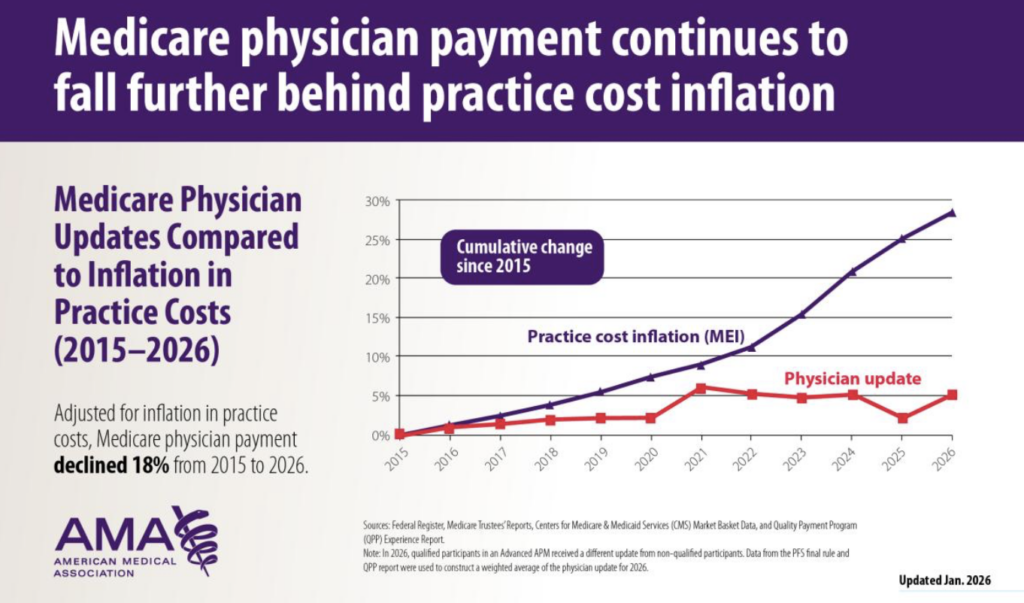
For years, physicians have watched reimbursement fail to keep pace with the cost of practicing medicine.
According to the American Medical Association, Medicare physician payment increased only about 10% between 2001 and 2026 while the cost of running a medical practice increased approximately 63%. The AMA previously calculated that inflation-adjusted Medicare physician payment declined 33% between 2001 and 2025.
That is a pretty incredible divergence.
I've written previously about why doctor pay is decreasing and about the importance of understanding physician compensation data.
This is not to say that every physician is underpaid or that every increase in healthcare spending is justified. It is simply important context.
For decades, the economic pressure on physician reimbursement has generally gone in one direction. Now a technology comes along that may help identify legitimate work and patient complexity that historically went undocumented. Reimbursement increases as a result. Suddenly we have a healthcare cost crisis?
You can understand why physicians might be a little skeptical.
The Real Healthcare Cost Problem Is Bigger Than Physician Reimbursement
There is another part of this story that bothers me.
Whenever healthcare costs rise, physician compensation seems to become an easy target. Yet the administrative machinery surrounding healthcare is enormously expensive.
A 2021 analysis published in JAMA estimated that administrative expenses account for roughly 15% to 25% of total U.S. healthcare expenditures, representing approximately $600 billion to $1 trillion annually based on 2019 spending. Another JAMA analysis estimated about $950 billion in nonclinical administrative spending in 2019 alone.
Think about that for a second.
We have built an extraordinarily complicated system in which hospitals employ people to figure out how to code care, insurance companies employ people to scrutinize those codes, physicians spend time documenting information to satisfy both groups, and everyone invests in increasingly sophisticated software to navigate the rules.
Research published in JAMA examining billing and insurance-related activities at one academic health system estimated administrative costs ranging from about $20 for a primary care encounter to more than $200 for an inpatient surgical procedure.
And now AI enters the picture.
My hope is not that we use artificial intelligence to make this administrative arms race even more complicated. My hope is that eventually AI helps us dismantle some of it.
AI Could Actually Reduce Healthcare Administrative Costs
This is where I see an enormous opportunity.
The most interesting implication of AI in healthcare may not be that it can help physicians or hospitals receive more reimbursement.
It may be that AI can automate enormous amounts of work that currently require humans sitting on both sides of the healthcare transaction.
Coding. Chart review. Prior authorization. Documentation. Claims processing. Appeals. Revenue-cycle management.
These functions are necessary to varying degrees in our current system. But they also consume an incredible amount of money and physician time without directly treating patients.
I have written before about how AI can increase clinical efficiency for doctors and why I think technology should ultimately create more room for physicians to think well.
The same principle applies here.
Artificial intelligence should not simply create increasingly sophisticated algorithms fighting over increasingly complicated billing rules. The bigger opportunity is to simplify the system. Imagine if AI healthcare tools could simultaneously reduce administrative labor while ensuring that the clinical work actually performed is accurately documented and reimbursed.
I do understand that this means potentially lost jobs. But I also think we need to improve efficiency in a responsible way in healthcare. This offers a path.
But I Suspect the Goalposts Will Move
Unfortunately, I am skeptical that this is where the story ends.
If AI medical coding consistently identifies additional legitimate diagnoses that increase reimbursement, insurers have an obvious financial incentive to respond.
The rules could change. Reimbursement formulas could be adjusted. Certain secondary diagnoses could carry less weight. Documentation requirements could become more stringent. In other words, the goalposts may move.
That would hardly be unprecedented in healthcare reimbursement.
Payment systems constantly evolve in response to incentives and utilization. Some of those changes are appropriate and necessary to prevent abuse. Others can increase complexity and create yet another layer of administrative work.
My concern is that we respond to better identification of legitimate clinical complexity by simply making legitimate complexity worth less.
That doesn't solve the underlying problem. It just changes who gets paid.
- I’m sitting down with Rob Anderson, founder of Carlton Lane Capital and a former real estate principal who ran capital markets alongside the development team, for a live Q&A about evaluating private investments.
- What makes a deal worth a closer look, and what usually goes wrong when investors get burned?
- How do debt, equity, and the terms of a deal change the risk behind a projected return?
- When is a tax benefit a genuine advantage, and when is it distracting from a weak investment?
Physicians Need to Understand the Economics of the Care We Provide
There is a broader lesson here for doctors.
We need to stop pretending that the economics of healthcare are somehow beneath us. Our job is absolutely to take excellent care of patients. But understanding how that care is documented, coded, valued, and reimbursed does not undermine that mission.
It protects it.
I've become increasingly convinced that physicians need to understand the value they bring to healthcare systems. That includes understanding our productivity, our outcomes, our clinical reputation, our downstream economic impact, and the services that would not exist without us.
I've written about four ways to define your value as a physician as well as why your clinical reputation can become one of your greatest sources of leverage.
This AI healthcare costs debate is another example of why that knowledge matters.
Because ultimately, patient care drives the healthcare economy. Without physicians, nurses, and other clinicians actually taking care of patients, there is nothing to code. There is nothing to bill. There is nothing to insure. And there is no revenue cycle to manage.
That doesn't mean physicians deserve unlimited reimbursement. It does mean that asking to be compensated appropriately for the care we provide is not greedy or somehow inconsistent with being a good doctor.
So What Should Physicians Actually Do?
This is still an emerging issue, so I don't pretend to have some perfect solution.
But there are a few principles that I think make sense.
First, code accurately.
That does not mean maximizing every possible code simply because you can. It means making sure the medical record accurately reflects the patient's conditions, the complexity of the care provided, and the procedures you actually perform.
If AI helps accomplish that more efficiently and accurately, I see that as a positive development.
Second, understand your own value.
Learn how your compensation works. Understand your RVUs if they are relevant to your practice. Know what comparable physicians are paid. Recognize the downstream value you create.
That knowledge has been extremely useful in my own contract negotiations.
Third, advocate for fair reimbursement and sensible payment policy.
That can mean participating in specialty societies, organized medicine, hospital committees, payer discussions, or communicating with elected representatives about physician payment policy. Individual physicians rarely control reimbursement structures, but physicians collectively should have a voice in how those structures evolve.
Finally, don't let the administrative system convince you that your clinical work is the problem.
AI Healthcare Costs May Be Telling Us Something Else
I understand why insurers are paying attention to this trend.
Nearly $1 billion is real money. If AI is driving inappropriate coding without any corresponding clinical justification, we should absolutely know about it and address it.
But that is not the only possible interpretation.
AI may also be exposing something that physicians have known for years. The care we provide is incredibly complex, and the system used to document and reimburse that care is incredibly inefficient. Maybe AI is finding diagnoses that shouldn't affect reimbursement. Or maybe it is finding clinical complexity that physicians have been managing all along without being appropriately credited for it.
Those possibilities require very different solutions.
For me, the bigger opportunity is obvious.
Use AI to reduce the staggering administrative burden in American healthcare. Use it to make documentation and coding more accurate. And use it to give physicians more time to actually care for patients.
And yes, if physicians and healthcare providers have historically been under-reimbursed because legitimate work wasn't being captured correctly, then technology helping correct that problem isn't necessarily something we should fear.
Maybe the billion dollars isn't the most interesting part of the story. Maybe it's what AI just exposed about the healthcare system we already built.
What do you think? Is AI increasing healthcare spending a sign of previous underpayment or adding unnecessary costs? What other lessons can the impact of AI on healthcare spending teach us? What is the optimal balance of AI in healthcare? Let me know in the comments below!