A few months ago, for the first time in my 6 years as an attending after finishing medical training, I made 3 new rules for myself in the operating room. I wouldn't operate at more than one hospital in the same day. I wouldn't schedule more than three elective cases, and if I was performing a microsurgical breast reconstruction, that would be the only elective case on my schedule. They weren't groundbreaking changes, but they were intentional ones. They gave me more margin to take care of patients, more flexibility if emergencies arose, and perhaps most importantly, a much better chance of making it to my kids' baseball games and practices this summer.
On paper, those decisions were easy. Yet when I started putting those boundaries into place, I noticed something surprising. A small part of me still felt guilty. There was still a voice in the back of my mind asking whether I should squeeze in one more case, say yes to one more opportunity, or simply work a little harder.
It's interesting because it had nothing to do with money (financially these decisions had little to no impact). Instead, I realized it had everything to do with the fifteen years I spent becoming a physician. Medical school, residency, and fellowship had taught me countless lessons that made me a better surgeon. They had also quietly shaped the way I thought about work, success, money, and even my own self-worth. Nobody ever talked about those lessons because they were never part of the official curriculum. Looking back now, I think they have influenced my financial life just as much as any investing book or spreadsheet ever has.

- I hosted a peer-led panel of physicians who actually work locums — an honest look at what they control and what they don’t.
- We got into schedule control, income and pay structure, W-2 vs. 1099, and life fit: burnout recovery, re-entry, testing a market, family and relocation.
- It ended with a live, unscripted Q&A — the questions were good, and the answers weren’t sugarcoated.
- Locumstory is a free educational resource about locum tenens, not a staffing agency. Watch the replay free, no registration pitch.
Explore Locumstory’s free resources
The education I never realized I was getting
When people think about medical training, they picture anatomy labs, overnight call, board exams, and endless hours in the hospital. That's certainly part of it. But every physician also graduates with another education, one that is never written into a syllabus. It's the collection of beliefs you slowly absorb simply by spending more than a decade inside the system.
For years, success is defined by following the next step. Finish your prerequisites. Get into medical school. Pass your boards. Match into residency. Impress your attendings. Complete fellowship. There is always another milestone waiting just ahead, and there is always someone else defining what success looks like. That structure exists for good reason. Patients deserve physicians who have completed rigorous, standardized training. I wouldn't change that for a second.
The unintended consequence is that we become incredibly good at following a roadmap someone else created
At the same time, we become accustomed to delaying almost every other part of our lives. We delay vacations, relationships, hobbies, financial planning, and often even our own health because there is always another exam or rotation demanding our attention. Somewhere along the way, many of us begin believing that life will finally begin after the next milestone. I certainly did. During residency I thought everything would feel different once I became an attending.
I remember sitting down with my wife, Selenid, to look over our finances shortly towards the end of training. I expected to feel relieved. Instead, I found myself staring at a spreadsheet showing a net worth of roughly negative $520,000. The debt itself wasn't the surprise. Like every physician, I knew medical education and training came with a price tag. What surprised me was realizing that after fifteen years of higher education, I had almost no idea what came next. I knew how to perform complex reconstructive surgery, but I didn't know whether I should prioritize investing or paying off debt. I didn't understand asset allocation, retirement accounts, taxes, or even how to evaluate whether financial advice was good or bad. For the first time in a long time, I wasn't just inexperienced. I was completely lost.
Becoming a student again
Looking back, I think that moment changed my life because it forced me to admit something physicians rarely enjoy admitting. I didn't know what I was doing.
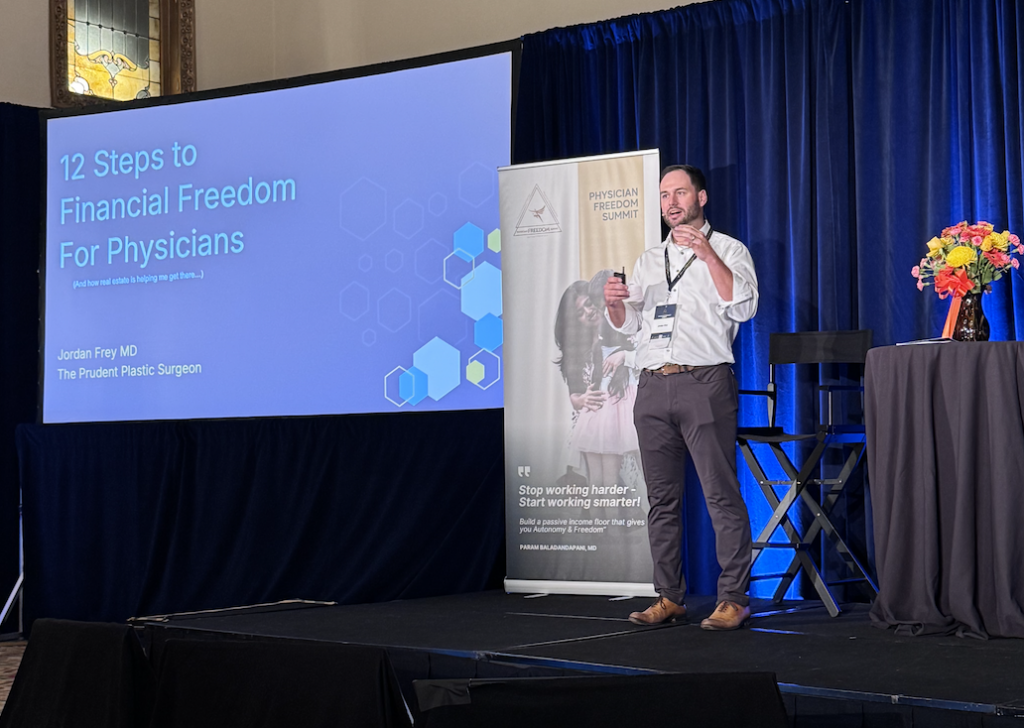
Medical training makes us experts. By the time we graduate, people come to us expecting answers. Patients ask difficult questions every day, residents look to us for guidance, and colleagues trust our judgment in high-stakes situations. Admitting ignorance doesn't come naturally after living in that world for so long.
Thankfully, my wife and I decided to approach personal finance the same way we had approached medicine: we became students again.
We started reading everything we could find. We discovered physician finance blogs, listened to podcasts during long commutes, read books about investing and behavioral finance, and slowly built a vocabulary that, in hindsight, I wish someone had introduced during residency. None of the individual concepts were especially complicated. Index funds weren't difficult to understand. Retirement accounts weren't mysterious. Even real estate investing eventually became far less intimidating than I had imagined. The challenge wasn't the material itself. The challenge was that nobody had ever pointed us toward it.
The biggest breakthrough wasn't our first investment property or watching our net worth climb. It was writing our first financial plan. Until then, every financial decision had felt isolated. When should we pay off this loan? Should we buy this house? Should we invest here or there? Once we had a written plan, every decision suddenly had context. We stopped asking whether something sounded like a good investment and started asking whether it moved us closer to the life we actually wanted to build. That subtle change completely transformed our relationship with money.
Financial freedom wasn't what I thought
For a long time, I assumed financial freedom meant retiring early. That's certainly the message many physicians hear. Work hard, save aggressively, and eventually escape medicine altogether.
Somewhere along the way, I realized that wasn't my goal at all.
I genuinely love being a plastic surgeon. I love teaching residents. And I enjoy solving difficult reconstructive problems and taking care of patients during some of the hardest moments of their lives. I never wanted to walk away from that. What I wanted was the ability to practice medicine without feeling like every decision had to maximize income as many doctors that I talk to who are living paycheck to paycheck to paycheck as high income earners in golden handoffs tell me they feel.
Ironically, that shift had very little to do with how much money we accumulated. As our investments grew and our financial plan matured, I noticed something much more important changing. I became more comfortable saying no. No to extra operating days that didn't fit my priorities. No to opportunities that looked impressive but pulled me away from my family. Even saying no to the constant feeling that working more was always the answer.
That's what those operating room boundaries were really about
They weren't scheduling rules. They were evidence that my mindset had finally begun to change. Coaching my sons' baseball teams, writing this blog, spending evenings with my family, and pursuing new interests (even if they are related to medicine) have become just as meaningful to me as another elective case on the schedule. Years ago, I don't think I could have made those choices, even if someone had handed me the exact same financial portfolio I have today. The obstacle wasn't simply money. It was the belief that my value as a physician depended on always producing more.
Medical training taught me that hard work solves almost every problem. Financial education taught me that sometimes the better answer is creating enough margin that you no longer have to solve every problem by working harder.
- I hosted a peer-led panel of physicians who actually work locums — an honest look at what they control and what they don’t.
- We got into schedule control, income and pay structure, W-2 vs. 1099, and life fit: burnout recovery, re-entry, testing a market, family and relocation.
- It ended with a live, unscripted Q&A — the questions were good, and the answers weren’t sugarcoated.
- Locumstory is a free educational resource about locum tenens, not a staffing agency. Watch the replay free, no registration pitch.
Explore Locumstory’s free resources
Maybe we need to change the curriculum
I don't think the solution is making medical training easier. The world needs exceptionally trained physicians, and becoming one should remain difficult. But I do think we can acknowledge that graduating outstanding clinicians and graduating financially healthy physicians are two entirely different goals. Right now we devote years to teaching future doctors how to care for patients while spending almost no time teaching them how to care for their own financial lives, which is a completely missed area of personal well-being in an age where most training programs espouse a “wellness” or “resilience” curriculum.
Imagine if every residency program included a handful of unbiased sessions on contract negotiation, retirement accounts, student loans, investing, taxes, insurance, and behavioral finance. Imagine if graduating residents understood the basics of a written financial plan before signing their first attending contract. I don't think every physician needs to become a financial expert, but I do think every physician deserves enough education to make thoughtful decisions and recognize when they need help.
On an individual level, I think the first step is much simpler than people realize
Become curious. Read one good finance book every few months. Listen to physician finance podcasts during your commute. Find mentors who have built lives you admire, not simply careers you envy. Most importantly, define what “enough” actually means for your family. If you never define enough, you'll spend your entire career chasing a finish line that keeps moving farther away.
When I look back now, I don't wish I had learned about investing earlier simply because I would have accumulated more wealth. I wish I had learned about it earlier because I would have discovered much sooner that money was never really the goal.
Autonomy was.
Medical training taught me how to reconstruct a breast, save a free flap, and teach the next generation of surgeons. Those lessons shaped the physician I am today, and I'll always be grateful for them. Learning about money taught me something equally valuable. It taught me how to build a life where I get to choose how I spend my time, how I practice medicine, and when enough is truly enough.
Looking back, I think every physician deserves that lesson long before graduation.
What do you think? What hidden curricula have you identified in your medical training? Did they all benefit you? How has your perspective shifted over time? How can we help promote well-being, financially and otherwise, in a new generation of doctors? Let me know in the comments below!